Your electric guitar sounded massive through the amp.
Then you dropped it into the mix, and it turned into a fizzy, muddy smear that either buries the vocal or vanishes behind the drums.
You reach for EQ, then a compressor, then a reverb, and somehow it sounds worse than the raw DI.
The tone was never the problem.
The problem is that a mixed electric guitar needs a handful of moves made in the right order, each one setting up the next.
This is the no-fluff chain: clean the frequencies, steady the dynamics, carve space against the vocal, then add depth and width last.
Follow it top to bottom, and the guitar snaps into focus without a single boutique plugin.
TL;DR
- Order matters: balance, subtractive EQ, compression, dynamic EQ or sidechain, and then effects.
- High-pass and cut first. Filter below 80 to 100 Hz, cut mud at 250 to 500 Hz, and tame fizz around 3 to 4 kHz.
- Compress for control, 3:1 to 4:1 on rhythm, and a slower attack on leads for sustain.
- Make room for the vocal with dynamic EQ or a gentle sidechain instead of just turning the guitar down.
- Add depth and width last: saturation for weight, reverb and delay for space, and double-tracking for size.
Keep reading for the frequency targets, the exact fixes for a muddy or fizzy tone, and the space tricks that let a wall of guitars share a mix.
The Step-by-Step Chain
Before any single plugin, know the sequence.
Each stage below hands a cleaner signal to the next, which is why order beats gear on an electric guitar.
Skip ahead to effects with a muddy tone and you will chase your tail all night.
- Balance the guitar against the drums and vocal at a low volume.
- Subtractive EQ to clear rumble, mud, and fizz.
- Compression to steady the level and shape the attack.
- Dynamic EQ or sidechain to carve space around the vocal.
- Saturation, reverb, and delay for weight, depth, and width.
How to EQ an Electric Guitar in a Mix
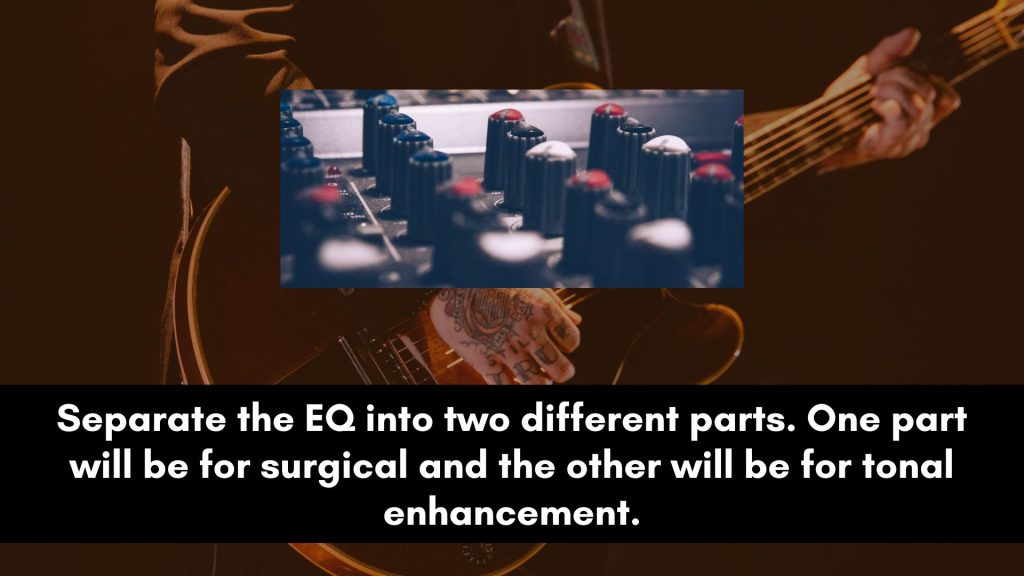
EQ is where most electric guitar mixes are won or lost.
The instrument is almost pure midrange, so it collides with the vocal, snare, and synths in the busiest part of the spectrum.
Cut before you boost, and cut with purpose.
Most tone complaints trace to one of a few zones. Use the table below to match the symptom to the fix instead of sweeping blindly.
| Symptom | Likely zone or tool | Fix |
|---|---|---|
| Muddy, congested | 250–500 Hz | Subtractive cut, high-pass below 80–100 Hz |
| Fizzy, brittle | 3–4 kHz and above 8 kHz | Cut the fizz, low-pass the extreme top if needed |
| Boxy, hollow | 400–800 Hz | Narrow cut where it barks |
| Thin, weak | 100–250 Hz or saturation | Gentle body boost or add harmonics |
| Buried under vocal | 1–3 kHz masking | Dynamic EQ or sidechain to the vocal |
| Harsh pick attack | 2–5 kHz transients | Slower compressor attack or a small cut |
Clean rhythm parts and high-gain tones want different degrees of the same moves, and a lead needs more presence than a rhythm bed.
The full frequency-by-frequency walkthrough, with the reasoning behind each cut, lives in how to EQ an electric guitar.
Compress for Tone and Control
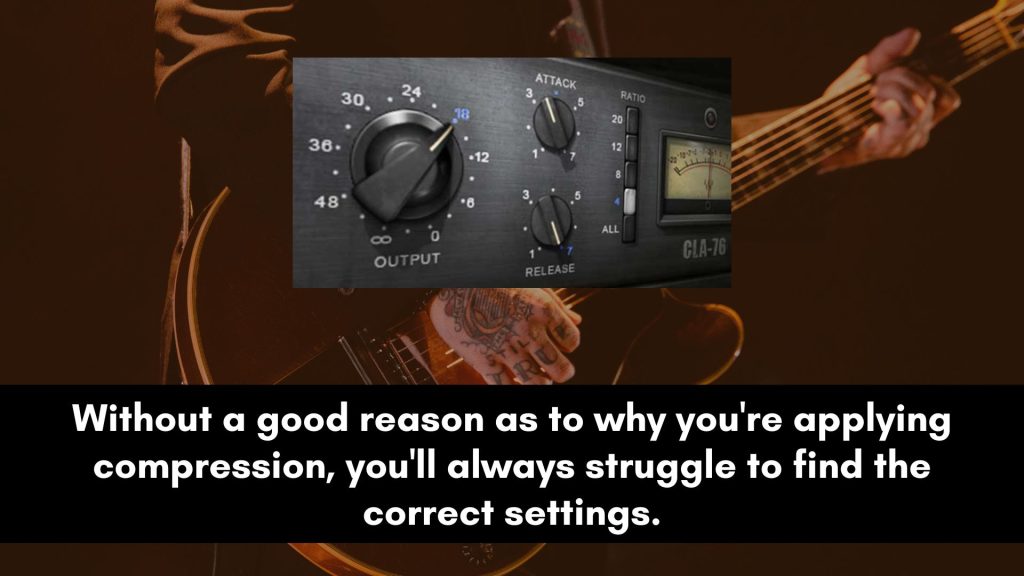
Compression keeps an electric guitar from lunging forward on loud chords and dropping out on quiet ones.
It also shapes the pick attack, which is half the character of a rhythm part. The settings depend on the job.
For rhythm, a 3:1 to 4:1 ratio with a medium attack of 10 to 30 ms tightens the strumming while keeping the pick.
For leads, slow the attack to 20 to 40 ms and raise the ratio so the compressor adds sustain and holds the note.
Keep gain reduction under 5 or 6 dB unless you want an obviously squashed effect.
High-gain tones are already compressed by the amp distortion, so they need less than a clean tone.
The attack and release choices that make or break the feel are broken down control by control in how to compress an electric guitar.
Match the Chain to Your Tone
No two electric guitar tones want the same treatment.
A jangly clean part and a scooped metal rhythm live in different parts of the spectrum and carry different dynamics.
Adjust how hard you lean on each stage based on the tone in front of you.
- Clean tones are the most dynamic, so they benefit most from compression and a little saturation for weight. Watch the low mids, which can turn boomy.
- Crunch and overdrive sit right on top of the vocal in the mids. Lean on subtractive EQ around 250 to 500 Hz and keep an eye on 3 kHz.
- High-gain and metal are already compressed by the distortion, so they need almost no compressor. The work is aggressive high-passing and fizz control up top.
- Leads want presence and sustain. Boost around 2 to 4 kHz to cut through, and compress with a slower attack so notes ring out.
When several of these tones share one song, give each its own frequency lane so they stack instead of smear.
That single decision does more for clarity than any plugin.
Carve Space With Dynamic EQ and Sidechain
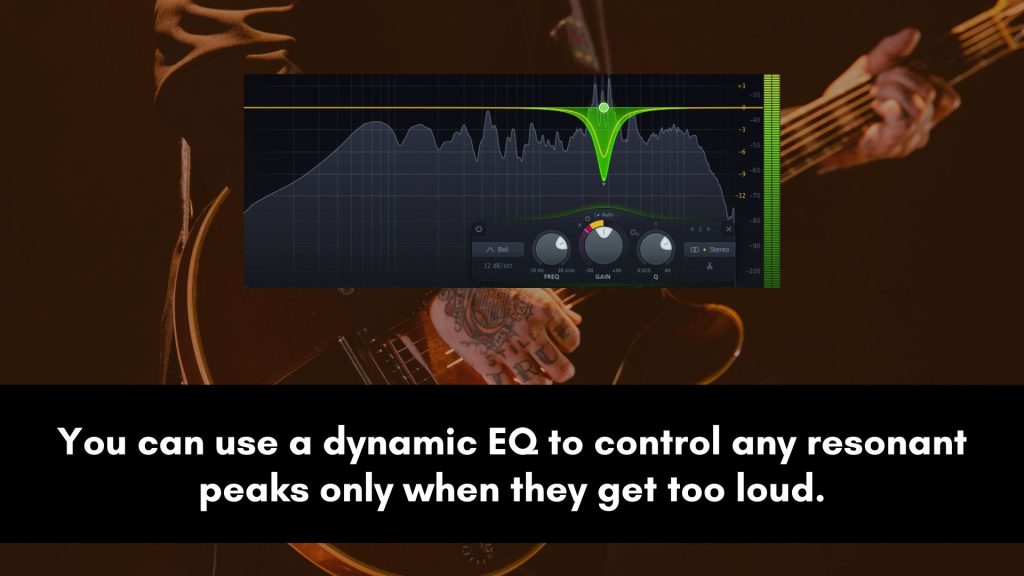
Static EQ solves constant problems.
But a guitar only clashes with the vocal when the vocal is actually singing, and cutting that range full-time robs the guitar in the instrumental sections.
This is where dynamic tools earn their place.
- Dynamic EQ dips a specific band only when it gets loud, so a guitar that turns harsh at 3 kHz on hard strums stays smooth without dulling the quiet parts.
- Sidechain the guitar to the vocal, triggering a small dip in the 1 to 3 kHz range whenever the vocal enters, so the words always stay on top.
- Resonance suppressors hunt down the sharp, ringing frequencies a distorted guitar throws off. A tool like Soothe2 does this automatically, covered in the Soothe2 plugin review.
The goal is a guitar that gets out of the vocal’s way on its own, instead of one you keep riding down with the fader.
Add Weight and Cut With Saturation
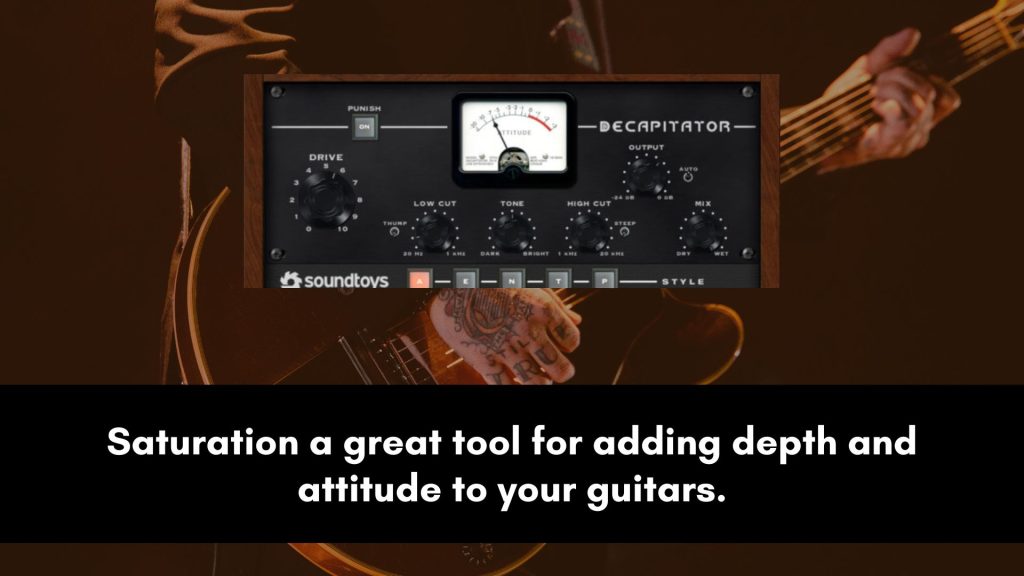
A clean DI or a thin amp sim often lacks the harmonic density that lets a guitar cut through on small speakers.
Saturation adds that density. It generates new harmonics that make the part feel bigger and more present without raising the fader.
Reach for a tape or tube style saturation on clean parts to add warmth and glue.
On an already distorted tone, use it sparingly, since piling drive on drive turns to noise fast.
A little goes a long way, so push it until you hear it, then back off.
Saturation also doubles as a subtle way to make a guitar feel louder without raising its level.
Because it adds upper harmonics, a saturated part reads as brighter and more present, which helps it survive on phone speakers and laptop drivers that roll off the lows.
Parallel saturation, blending a driven copy under the clean track, gives you that presence while keeping the original dynamics intact.
Reverb and Delay for Space and Width
Effects come last, once the tone and dynamics are locked. Reverb and delay decide how far back the guitar sits and how wide it spreads.
Add them on sends so several guitars can share one space and glue together.
Reverb sets depth.
A short room keeps a rhythm part tight and close, while a longer hall or plate pushes a lead back for drama.
Delay handles width and movement.
A tempo-synced slap or eighth-note delay thickens a lead and fills the stereo field without the wash a big reverb adds.
The full pairing of reverb type to guitar part is laid out in reverb on guitar.
Make Electric Guitars Bigger and Wider
Size on an electric guitar comes from real stereo information, not a widener plugin slapped on a mono track.
The classic move is double-tracking, and it beats any effect for natural width.
Record the rhythm part twice, pan one take hard left and the other hard right, and the guitar wraps around the listener while the center stays clear for the vocal and snare.
Slightly different tones or performances on each side widen the image even further.
For the deeper detuning, layering, and stereo tricks, how to make guitars bigger collects the ones that actually work.
3 Common Mistakes
A few habits sink more electric guitar mixes than any missing plugin. Avoid these, and the chain above does most of the work for you.
- 1. Keeping the low end. Distorted guitars carry a lot of energy below 100 Hz that fights the kick and bass. High-pass it and the low end tightens instantly.
- 2. Stacking too many tracks. Four mono rhythm takes in the center turn to mush. Two well-panned tracks almost always sound bigger than six piled up.
- 3. Fixing tone with effects. Reverb cannot rescue a fizzy EQ. Get the frequencies and dynamics right first, then reach for space.
Frequently Asked Questions
The questions below come up on nearly every electric guitar mix. Short, direct answers follow.
How do you make an electric guitar sit in a mix?
Start with balance, then carve the frequencies. High-pass below 80 to 100 Hz, cut mud around 250 to 500 Hz, and tame fizz near 3 to 4 kHz.
Compress lightly to steady the level, then use dynamic EQ or a sidechain to duck the guitar under the vocal when it enters.
A guitar sits when it stops competing with the vocal and the low end, not when you simply turn it up.
Should you high-pass an electric guitar?
Yes, in almost every mix.
A high-pass filter around 80 to 100 Hz removes rumble and low-end energy that a distorted electric guitar produces but does not need.
That range belongs to the kick and bass.
Filtering it out clears headroom and tightens the whole low end, and you rarely lose anything musical, since the guitar’s body sits higher, around 100 to 250 Hz.
How do you fix a harsh or fizzy electric guitar?
Harshness usually lives around 3 to 4 kHz, and fizz sits above 8 kHz.
Cut the harsh band with a narrow EQ, and if the extreme top is still spitting, add a gentle low-pass filter to roll it off.
A dynamic EQ or resonance suppressor works well when the harshness only appears on loud strums.
Since it acts only when the problem frequency spikes rather than dulling the tone full-time.
Do you compress before or after EQ on electric guitar?
A common order is subtractive EQ first, then compression, then a small tone EQ.
Cutting mud and rumble before the compressor stops it from reacting to low-end energy you were going to remove anyway.
That said, some engineers compress first to even the dynamics, then EQ the steadier signal.
Both work, so try the cut-then-compress order first and adjust if the result feels off.
How many electric guitar tracks should a mix have?
Fewer than you think.
Two well-recorded rhythm takes panned hard left and right usually sound bigger than four or six stacked in the center.
Add tracks only when each one has a clear job, such as a lead, a texture layer, or an octave part.
Extra guitars in the same range just add mud and eat headroom, so separation and panning beat sheer track count.
What order do effects go in on an electric guitar?
Tone and dynamics come before time-based effects. A typical order is EQ, then compression, then saturation, then reverb and delay on sends.
Placing reverb and delay last means they react to a clean, controlled signal instead of smearing a muddy one.
Keep the space effects on aux sends so multiple guitars can share one reverb and glue into the same room.
The Bottom Line
Mixing an electric guitar is a sequence, not a secret. Clean the frequencies, steady the dynamics, and carve space against the vocal, then add depth and width.
Do it in that order, and even a plain amp-sim tone locks into the mix.
Electric is only one half of the guitar picture, and acoustics or a full multi-guitar arrangement play by slightly different rules.
When you want the wider view across every guitar type, the complete guide to mixing guitars ties the whole approach together.
Trust your ears at low volume, and the fizz and mud stop being a fight.