You do not need a lecture every time you reach for an EQ on the bass. You need to know where to grab.
Where the mud is, where the punch lives, and which frequency makes the bass disappear on a phone.
This is the quick-reference cheat sheet.
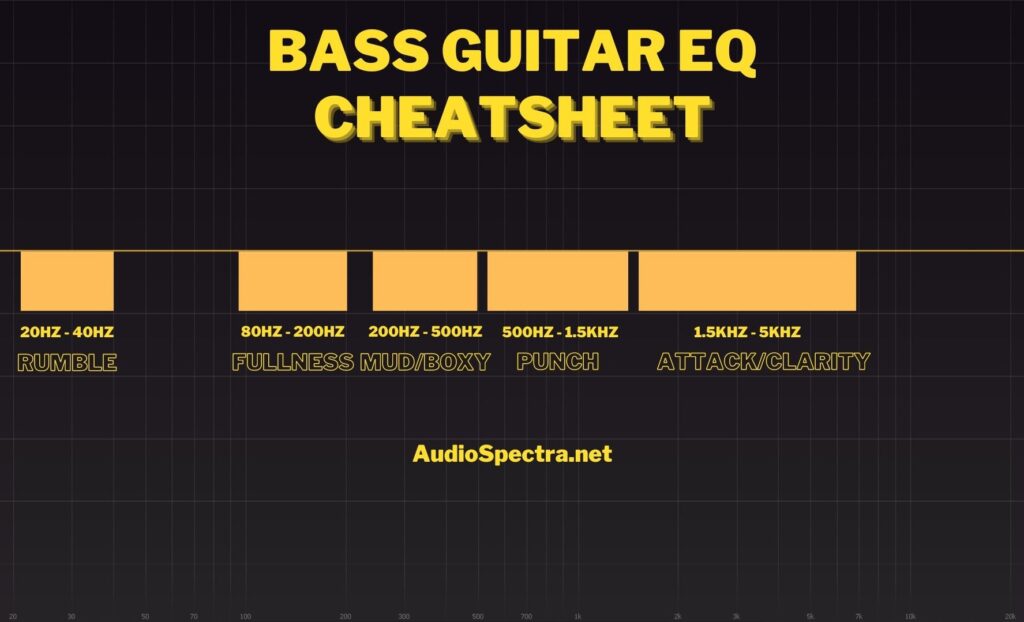
The table below maps every important bass frequency in one place, with what lives there and the move that usually fixes it.
Use it as a starting point and sweep to confirm on your own bass, since the exact spots shift with the instrument, the strings, and the playing style.
When you want the full reasoning behind these moves, the step-by-step guide to EQing bass guitar walks through the whole method.
Bass EQ Frequency Cheat Sheet
Here is the whole frequency map for bass guitar.
Find the zone, see what lives there, and make the move.
Cut before you boost, and always confirm the final balance with the full mix and the kick playing.
| Frequency | What lives there | Move |
|---|---|---|
| Below 30–40 Hz | Subsonic rumble, no music | High-pass to save headroom |
| 40–80 Hz | Sub weight, deep rumble | Boost gently for power, watch the kick |
| 80–200 Hz | Body, fundamental, warmth | Boost for weight, cut if boomy |
| 200–400 Hz | Mud, boxiness, clutter | Cut to clean up |
| 700 Hz–1 kHz | Punch, grind, low-mid definition | Boost to cut through |
| 1–3 kHz | Note definition, articulation | Boost for clarity |
| 4–6 kHz | String, pick, and finger attack | Boost to translate on small speakers |
The Low End: Sub and Body
The bottom two zones carry the weight, and they are where the bass either feels powerful or turns to soup.
The split between sub and body is the one to understand because they do different jobs and need different handling.
High-pass below 30–40 Hz to clear subsonic rumble that only wastes headroom.
The 40–80 Hz sub gives the deep weight you feel on big systems, so boost it gently and watch how it stacks with the kick.
The 80–200 Hz body holds the fundamental and warmth, which is the core of the bass tone, so boost for weight or cut if it sounds boomy and undefined.
The Mud Zone: 200–400 Hz
If the bass sounds boxy, cluttered, or like it is clouding the whole mix, the problem almost always lives here.
The 200–400 Hz range builds up fast and is the most common bass cut you will make. It is also the easiest win.
Sweep a narrow boost through the range to find the muddiest spot, then cut a few dB right there.
Clearing this zone usually makes the bass feel bigger, not smaller, because the weight underneath can finally be heard.
Keep the cut tight so you remove the box without draining the body.
Punch and Clarity: 700 Hz to 6 kHz
The upper zones are what make a bass cut through and translate on small speakers.
Phones and laptops cannot reproduce the lows, so this is the range that keeps the bass audible everywhere.
It is the most underused part of bass EQ.
- 700 Hz–1 kHz: punch, grind, and low-mid definition. Boost to help the bass cut through a busy mix.
- 1–3 kHz: note articulation and attack. Boost for clarity so each note reads.
- 4–6 kHz: string, pick, and finger noise. Boost so small speakers have something to play.
Quick Moves by Goal
When you already know the problem, jump straight to the fix.
These are the most common bass EQ goals and the move that gets you there fastest.
- Too muddy: cut 200–400 Hz.
- Too thin: boost 80–150 Hz.
- No punch: boost 700 Hz–1 kHz.
- Lost on small speakers: boost 1–6 kHz for harmonics.
- Clashing with the kick: carve complementary bands so each owns its space.
- Too much rumble: high-pass below 30–40 Hz.
The kick relationship is the one that needs the most care, since both instruments fight for the low end.
The kick drum EQ guide covers the other half of that carve, and the drum EQ cheat sheet maps the whole kit the same way this page maps the bass.
How to Use This Cheat Sheet
A frequency chart is a starting point, not a preset.
The numbers get you close fast, but the right moves depend on the specific bass and the mix it sits in.
A few rules make the cheat sheet actually work.
- Cut before you boost. Clear the mud first, then add punch and clarity.
- Sweep to confirm. Use the numbers as a place to start hunting, not as exact targets.
- Judge in the mix. Make the final balance calls against the kick and the full arrangement.
- Check small speakers. Confirm the bass still reads on a phone, not just on monitors.
These habits are what turn a frequency chart into a finished bass tone. The compression and routing that finish the job live in how to mix bass guitar.
Frequently Asked Questions
Quick answers to the questions that come up most when EQing bass guitar.
What is the best EQ setting for bass guitar?
There is no single setting.
A reliable starting point is to high-pass below 30–40 Hz, cut mud around 200–400 Hz, set the body around 80–150 Hz, and boost 700 Hz–1 kHz for punch with 1–6 kHz for clarity.
Sweep each to find the exact spot on your bass, then balance against the kick and the full mix rather than trusting fixed numbers.
What frequency is muddy bass?
Bass mud and boxiness live in the low mids, usually 200–400 Hz.
Sweep a narrow boost through that range to find the most cluttered, boxy spot, then cut a few dB there.
This is the most common and effective bass cut, and it often makes the low end feel bigger, since the weight underneath is no longer masked by the clutter above it.
What frequency makes bass punchy?
Punch and grind sit in the low mids around 700 Hz to 1 kHz, while the weight sits lower around 80–150 Hz.
Boost the low mids for definition and attack, and keep the body controlled so the punch is not buried under boom.
Clearing the 200–400 Hz mud first makes a punch boost far more effective because the definition is no longer masked.
Where do you high-pass a bass guitar?
High-pass below 30–40 Hz on most bass tracks.
There is little useful musical content down there, just rumble and subsonic energy that wastes headroom and clouds the mix.
Use a gentle slope, push it up while listening for the point where the bass starts to lose weight, then back off.
Be more conservative on sub-heavy genres where the lowest octave matters.
How do you make bass cut through small speakers?
Add upper harmonics.
Phones and laptops cannot reproduce low bass, so boost the 700 Hz–1 kHz grind and the 1–6 kHz string and pick attack, which small speakers can play.
The brain then fills in the missing low fundamental.
Light saturation can generate these harmonics if EQ alone is not enough, and a quick check on a phone speaker confirms it translates.
How do you EQ bass and kick together?
Use complementary EQ so each owns a different band.
Let the kick own the punch around 60–100 Hz and the bass own the body just above, or the reverse, cutting the bass where the kick thumps and cutting the kick where the bass sustains.
Sidechain compression on the bass keyed from the kick reinforces this, ducking the bass slightly on each kick hit.
The Bottom Line
Bookmark the table, and the rest is muscle memory: high-pass the rumble, cut the 200–400 Hz mud, set the body, and add punch and clarity up top.
Carve it all around the kick, sweep to confirm, and check on a small speaker. That is the whole bass EQ map on one page.
This cheat sheet is the fast reference. The complete EQ guide covers the technique behind every move across the whole mix.
Once the bass sits right on its own, the mix bus EQ is where it gets fitted against everything else.