Your string parts sound lush soloed, then they hit the mix and turn into a scratchy, harsh, muddy mess.
The violins get screechy in the highs, the cellos boom and clash with the bass, and a full ensemble piles into one cluttered wall that fights the vocal.
So you cut the harshness, and the strings go dull, or boost for brilliance, and the bow scratch jumps out.
Strings cover a huge range, and each instrument needs its own approach.
Good string EQ is about treating each instrument for its range, taming the scratch, and carving the ensemble so it sits as one.
This guide walks the full method.
You will learn where each string instrument sits, how to control bow scratch and harshness, how to add warmth and air, and how to fit multiple strings together without clutter.
TL;DR
- High pass each instrument to its range: high for violin, low for cello and double bass.
- Cut mud at 200–400 Hz where most strings get boxy and cluttered.
- Tame scratch and harshness at 2–6 kHz with a cut or dynamic EQ.
- Add warmth in the low mids and air above 8–10 kHz to taste.
- Carve the ensemble so cello owns the lows and violin owns the highs.
Keep reading for the step-by-step method, a per-instrument frequency table, and how to mix a full string section without clutter.
String EQ Frequency Table
Here are the key ranges for the most common string instruments in one place.
Treat them as starting points and sweep to confirm, since they shift with the instrument, the player, and the mic.
Always balance the final tone against the full mix.
| Instrument | High-pass | Warmth / body | Presence / cut harshness |
|---|---|---|---|
| Violin | ~80–120 Hz | 200–350 Hz | 2 kHz presence, tame 4–7 kHz scratch, 8 kHz+ air |
| Viola | ~80–100 Hz | 250–400 Hz | 2–3 kHz presence, tame 4–6 kHz |
| Cello | ~40–60 Hz | 400–600 Hz | 6–8 kHz for bow definition |
| Double bass | ~30–40 Hz | 100–250 Hz | 1–3 kHz for note attack |
| Banjo / mandolin | ~120–200 Hz | 250–500 Hz | 2–5 kHz attack, tame harsh 5–8 kHz |
The Step-by-Step Process
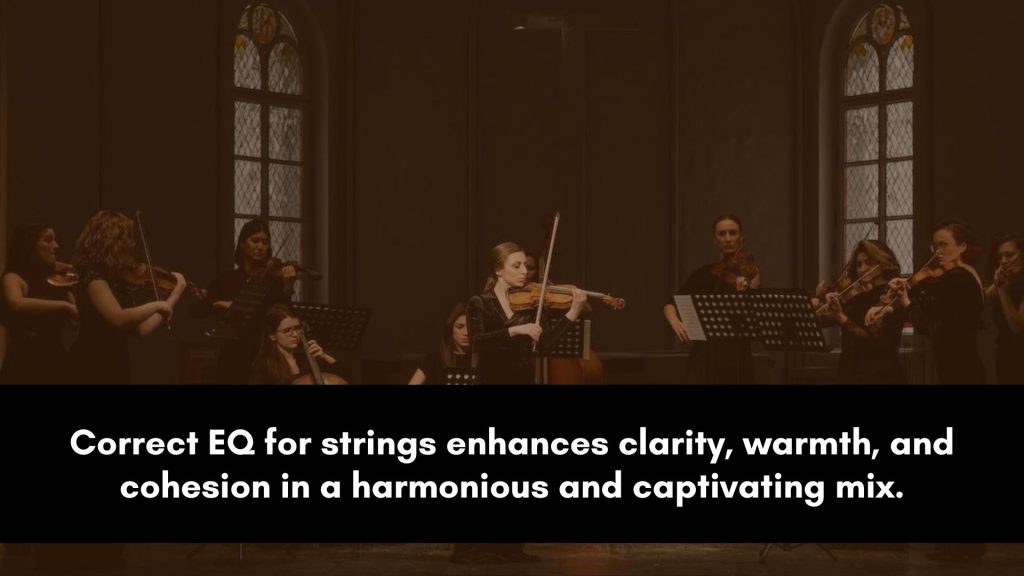
String EQ works best as a fixed order: filter to the instrument’s range, clear the mud, tame the scratch, then add warmth and air.
Cutting before boosting keeps the wide string range under control and stops you amplifying bow noise.
This is the flow the rest of the guide follows.
- High pass to the instrument’s range, high for violin, low for cello and bass.
- Cut the mud around 200–400 Hz to clear boxiness.
- Tame scratch and harshness in the 2–6 kHz range.
- Add warmth in the low mids if the tone is thin.
- Add air above 8–10 kHz, then balance against the full mix.
Find precise problem frequencies in solo, but make the final calls in the mix, especially against the vocal and any pads or piano that share the strings’ range.
EQ Violin and Viola (the High Strings)
Violin and viola live in the upper range, so the work is mostly about controlling brightness and bow scratch while keeping warmth.
They are the strings most likely to turn screechy in a mix, so restraint up top matters.
- High pass around 80–120 Hz: these instruments carry little useful low end, so clear the rumble.
- Warmth at 200–400 Hz: a gentle boost keeps the tone full, or cut if it is boomy.
- Presence at 2 kHz: a small boost adds vibrancy and excitement.
- Tame scratch at 4–7 kHz: cut or dynamically dip the harsh bow noise, then add air above 8 kHz if needed.
EQ Cello and Double Bass (the Low Strings)
Cello and double bass anchor the low end of the string family, so the focus shifts to controlling boom and clarifying the lows.
They overlap with the bass guitar and kick, so they need the same low-end discipline.
- High pass low: around 40–60 Hz on cello, 30–40 Hz on double bass, so you keep the weight.
- Check mud at 200–300 Hz: cut if the low end is cluttered.
- Warmth at 400–600 Hz: a wide boost adds richness and body.
- Definition at 6–8 kHz on cello, 1–3 kHz on bass: brings out the bow and note attack so the line reads.
When these low strings share a mix with bass guitar, carve them apart the same way you would the bass and kick, which the mix bus EQ guide ties together at the master level.
EQ Banjo and Mandolin (Plucked Strings)
Banjo and mandolin are plucked rather than bowed, so the attack matters more than sustain.
That puts them close to an acoustic guitar, another plucked, wood-bodied source where pick attack rules.
They are bright and percussive by nature, which means the job is keeping the snap while taming the harshness and clearing the low-end clutter.
High-pass firmly, around 120–200 Hz, since these instruments carry little useful low end and add clutter to a folk or bluegrass mix.
Add body around 250–500 Hz, boost 2–5 kHz for the pick attack and clarity, and cut any harsh, clanky ring in the 5–8 kHz range.
Keep the brightness that gives them their character, but tame the parts that fatigue the ear.
Mix a Full Section Without Clutter
A full string section is where clutter takes over, because every instrument overlaps in the mids.
The fix is the same complementary EQ used elsewhere: give each instrument its own lane so the ensemble reads as one rich sound instead of a muddy wall.
It is the same carving that keeps a dense piano part from clouding everything around it.
Let the cello and double bass own the lows and low mids, while the violins own the presence and air up top, cutting each where another instrument needs to shine.
Pan the sections across the stereo field to separate them further, and treat the ensemble on a bus so it sits as a unit.
The goal is a section that feels lush and wide, not crowded.
Fit the Section Around the Vocal
Strings often play under a vocal, and the violins share the same presence range that makes a voice clear.
When they pile up there, the vocal gets buried, so the strings have to step back in that zone. Complementary EQ keeps both clear.
Where the vocal needs presence around 2–4 kHz, dip the strings slightly so the voice sits on top, the same carving covered in the guide to EQing vocals.
Strings make a beautiful bed for a vocal precisely because they can give up that midrange and fill the space around it.
Balance the two together rather than perfecting each alone.
3 Common Mistakes
A few habits keep strings harsh and cluttered. Avoid these, and the method above lands.
1. EQing every string the same. A violin and a cello live in completely different ranges, so one setting leaves one harsh and the other muddy.
Treat each instrument for its own range.
2. Boosting highs for brilliance. Adding top to a scratchy string just amplifies the bow noise. Tame the 4–7 kHz scratch first, then add air only if the tone still needs it.
3. Leaving the ensemble uncarved. Stacked strings pile up in the mids and turn to mush. Carve each instrument into its own lane and pan the sections so the ensemble stays clear.
Frequently Asked Questions
Quick answers to the questions that come up most when EQing string instruments.
What frequencies should I cut on strings?
The two main cuts are the low-mid mud around 200–400 Hz, where most strings get boxy, and the harsh bow scratch around 4–7 kHz on bowed instruments.
High-pass each instrument to its range first: high for violin and viola, low for cello and double bass.
Sweep to find the exact mud and scratch frequencies on each instrument, since they vary with the player and the mic.
How do you fix scratchy or harsh strings?
Cut, do not boost. Bow scratch and harshness on violins and violas usually sit around 4–7 kHz, so sweep a narrow band to find the worst spot and dip it.
A dynamic EQ that only acts on the harsh moments keeps the strings bright on quieter passages.
Avoid adding high-end air until the scratch is under control, since boosting the top just amplifies the noise.
Where should you high-pass a violin?
High-pass a violin around 80–120 Hz.
It carries little useful energy below that, so filtering clears rumble and low-end mud without thinning the tone, and it leaves room for the cello, bass, and other low instruments.
Push the filter up while listening for the point where the violin starts to lose warmth, then back off.
Viola sits slightly lower, so filter a touch below the violin.
How do you EQ a cello to sit in a mix?
High-pass the cello around 40–60 Hz to keep its weight while clearing rumble, then check for mud around 200–300 Hz and cut if cluttered.
Add warmth with a wide boost around 400–600 Hz, and bring out the bow definition around 6–8 kHz so the line reads.
When the cello shares the low end with bass guitar, carve the two apart so each owns its own range.
How do you mix multiple string instruments together?
Use complementary EQ so each instrument owns a lane.
Let the cello and double bass hold the lows and low mids, and let the violins own the presence and air, cutting each where another needs to shine.
Pan the sections across the stereo field to separate them, and process the ensemble on a bus so it moves as one.
The aim is a lush, wide section rather than a muddy wall.
How do you keep strings from burying the vocal?
Carve the strings around the vocal in the shared presence range.
The violins and the lead vocal both want 2–4 kHz, so where the vocal needs presence, dip the strings slightly to open a lane for the voice.
Strings make a great bed for a vocal because they can give up that midrange and fill the space around it.
Always balance the two together rather than in solo.
The Bottom Line
String EQ comes down to treating each instrument for its range, then carving the ensemble.
High pass to the instrument, cut the 200–400 Hz mud, tame the 4–7 kHz scratch, and add warmth and air to taste.
Give the cello the lows and the violins the highs, fit the section around the vocal, and make the calls in the full mix.
Do that and the strings sound lush and clear instead of scratchy and cluttered.
No section spreads across the spectrum quite like strings, yet the same filter, cut, and carve order runs every source in a mix.
The complete EQ guide shows how that method applies once you step past the string section.
Tone is only part of a string sound.
Reverb and space, level balance, and the rest of the chain are covered in the full string mixing guide.
Great information, thanks. The download option for the strings compression cheat sheet is not working – you might need to update a link or something.
Hi Allyson, I appreciate the positive feedback. There’s no link for the cheat sheet; you have to enter your email, click download, and it will be sent to your email account.
THANKS