You finish a mix. It sounds wide and full on your monitors.
You hit the mono button on the master, and the bass disappears, the snare goes hollow, and the cymbals collapse into a wash of midrange.
Half the elements you carefully panned vanish. The mix that was wide and full is suddenly thin and small.
Mono and stereo are not just two flavors of the same thing. They are fundamentally different ways of presenting audio.
The choice between them affects everything from translation to phase to how much speaker mass drives the low end.
Most beginner mixes fail in mono because they were never built with mono in mind in the first place.
The two formats are simple; the decisions are where mixes go wrong.
What follows: what each format actually is, the physics behind the one universal rule (low frequencies stay mono), and the per-element defaults that fall out of it.
Once the model clicks, most mono-or-stereo calls stop being calls at all.
TL;DR: Mono vs Stereo in 30 Seconds
The shortest version of the rule. Apply this to every source decision, and most of the work is done.
- Mono = one channel. Same signal in both speakers. No directional information.
- Stereo = two channels. Left and right can differ. Width and placement come from the difference.
- Record mono for kick, snare, bass, single-mic instruments, and single vocals.
- Record stereo for overheads, drum rooms, piano, harp, and real string sections.
- Mix the kit’s stereo image through panning mono close mics across the field.
- Mono compatibility is non-negotiable. Phones, club PAs, and Bluetooth speakers all play in mono or near-mono.
What Mono Actually Is
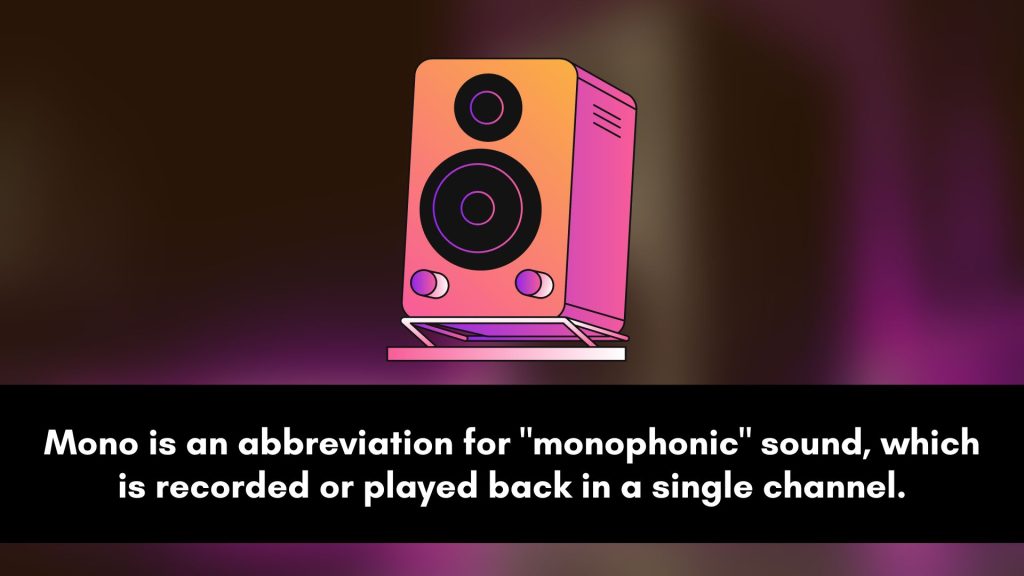
A mono signal is a single audio channel.
When you play it back through stereo speakers or headphones, the exact same waveform plays out of both sides.
There is no left-right difference, so the listener perceives the sound as coming from a single point in the center of the stereo field.
Mono is the foundation of every mix. A single microphone on a kick drum produces a mono recording.
A bass guitar DI is mono. A direct vocal capture is mono. The vast majority of individual tracks in any modern session start out as mono channels.
Mono sources do not have to stay center-panned, but the source itself is mono. A mono guitar panned 40 percent right is still a mono signal.
The panning places it in the stereo field, but the underlying recording remains a single channel. The pan knob sends that single channel at different levels to the left and right speakers.
What Stereo Actually Is
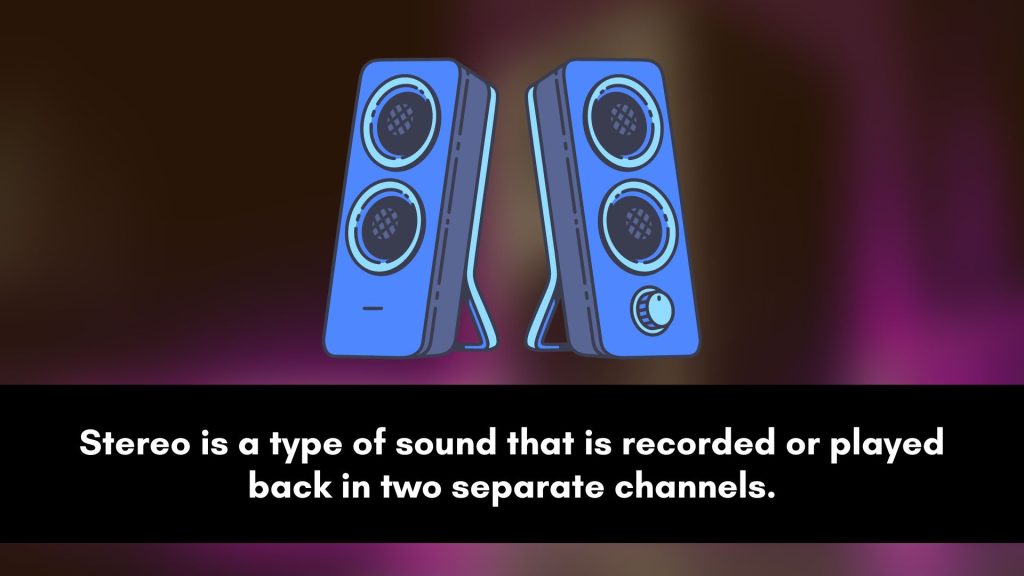
A stereo signal is two audio channels, one for left and one for right, that can carry different information.
The difference between the channels is what creates the perception of width, depth, and placement.
Stereo recordings use two microphones (XY pair, ORTF, spaced pair, Glyn Johns, or Decca tree) to capture a single source from two perspectives.
The two channels carry the same instrument but with slight differences in timing and level that the ear interprets as spatial information.
Played back through stereo speakers, the result feels three-dimensional. Stereo also exists as an effect rather than a recording.
Reverbs, delays, choruses, and synth pads can output stereo from a mono input by introducing artificial channel differences.
These are not stereo recordings; they are stereo processing of mono sources.
The distinction matters for translation, because real stereo recordings tend to sum to mono cleanly while artificial stereo effects often partially cancel.
The Physics: Why Low Frequencies Stay Mono
Two physical facts drive the universal rule that low frequencies stay mono in the center. Both are non-negotiable; ignoring either one costs you translation and impact.
First, low frequencies are non-directional.
The ear cannot tell which speaker a 60 Hz tone is coming from because the wavelength (about 5.7 meters at 60 Hz) is larger than the distance between your ears.
Panning low-end sources off-axis wastes their impact on width nobody can hear.
Second, stereo low end creates phase problems on mono playback.
When the same low-frequency content sits in both channels with slightly different timing or phase, summing to mono causes partial cancellation.
A bass that sounds full in stereo can lose 3 to 6 dB of low end the moment it plays on a phone or Bluetooth speaker.
Forcing mono below 100 to 150 Hz protects against this entirely.
The fix on the master is a mono utility, or a stereo imager with its crossover set so everything under 150 Hz sums to mono.
The kick, bass, and sub elements stay mono and centered automatically; high-frequency content above that band keeps its stereo width unchanged.
When to Record Each One
The recording decision is simpler than the mixing decision. Single-source close mics are mono; stereo recordings exist for sources where the spatial information is part of the sound.
Record mono when: the source has a single point of origin (kick, snare, tom, bass DI, single vocal, single guitar amp, hi-hat close mic).
One microphone, one channel, one captured perspective.
Record stereo when: the source has natural spatial spread that you want to capture (drum overheads, drum room mics, real piano, harp, real string section, orchestral ensembles, and large acoustic spaces).
Use a coincident pair (XY) or spaced pair (AB, ORTF) and treat the two channels as a permanent stereo unit through the mix.
You do not need two microphones in the same room to record in stereo, but you do need two channels of capture.
A stereo synth, a stereo sample library, or a stereo effect output also counts as stereo content; the principle is two-channel separation, not necessarily two physical microphones.
Decision Cheat Sheet
The quick-reference table covering the mono-or-stereo decision for every common source.
Use it as the starting point for any session and override only when the genre or arrangement gives you a reason.
| Source | Default | Reason | Exception |
|---|---|---|---|
| Kick drum | Mono, center | Low frequencies non-directional; speaker mass for impact | None worth taking |
| Snare drum | Mono, center | Backbeat anchor; listener tracks like a vocal | Stereo reverb on send only |
| Toms (close mics) | Mono, panned across | Each mic is single-source; image from panning | – |
| Hi-hat (close mic) | Mono, off center | Single source; matches overhead position | Programmed trap hats spread |
| Overheads | Stereo pair | Captures kit spatial image | Mono OH for vintage / lo-fi |
| Room mics | Stereo (if pair) or mono | Room sound is the spatial info | Match the recording setup |
| Bass guitar / 808 | Mono, center | Sub frequencies non-directional | None |
| Lead vocal | Mono, center | Single-source mic capture | Stereo reverb / delay on send |
| Doubled vocals | Mono each, hard-panned pair | Two mono takes; image from panning | – |
| Single guitar | Mono | Single amp / single DI capture | – |
| Stereo piano sample | Stereo | Sample captures natural spread | Mono for tight focused part |
| Synth pad | Stereo | Modulation creates natural width | HPF below 150 Hz before going wide |
| Reverb / delay return | Stereo | Wet effect adds width to mono dry | Mono reverb for vintage character |
| Sub / 808 bass | Mono, center | Pure low end; never stereo | None |
Mixing in Mono as a Check
Nobody mixes in mono from start to finish.
The working pattern is stereo for the decisions and mono for the audit, over and over through the session.
The audit reveals phase problems, level imbalances, and frequency masking that stereo width can hide.
Toggle a mono utility on the master at regular intervals.
Three symptoms matter: bass that thins out (phase trouble), parts that vanish (fake stereo width cancelling), and parts that suddenly leap forward (a balance that only worked in stereo).
Make the repairs in stereo with the audit off, then audit again.
A mix that sounds great in stereo and acceptable in mono is a finished mix. A mix that sounds great in stereo and falls apart in mono is not done.
Building width that survives the sum is its own discipline, and mixing in stereo without sucking in mono is where this post hands off.
Per-Element Decisions
The default mono-or-stereo choice changes by element.
The rule of thumb above covers most cases; the per-element posts below cover the nuances and the per-genre exceptions.
Drums. Kick and snare close mics mono, panned center. Hi-hat close mic mono, off-center.
Tom close mics mono, spread across the kit. Overheads stereo. Room mics stereo if captured as a pair.
Should drums be mono or stereo settles this element by element, trap-hat exceptions included. For the kit beyond this one decision, the complete drums mixing guide is the wider map.
Vocals. Lead vocal mono, panned center. Doubled vocals are two mono takes hard-panned opposite each other.
Background vocals spread around the lead, with each harmony pair often hard-panned. Stereo reverb and delay on sends create the width without pulling the dry vocal off center.
The full vocal chain is in the complete vocal mixing guide.
Bass. Always mono and centered. Even when the bass is processed through stereo effects (chorus, modulation, parallel saturation), the dry fundamental stays mono.
Bass low-end content panned off-axis loses impact and creates mono-compatibility problems.
3 Common Mono/Stereo Mistakes
Mono damage comes from a short list of habits, and these three top it. Each one takes a minute to fix once spotted.
- 1. Stereo-widening mono sources. Fake width is phase trickery, and phase trickery cancels. On mono playback the widened guitar, snare, or vocal drops in level or disappears; even in stereo it smears the transients. Build width through panning multiple mono sources or stereo effects on sends, not by faking it on the original mono signal.
- 2. Stereo low end. Below 100 to 150 Hz the ear cannot place a sound anyway, so stereo bass content buys nothing and risks cancellation on every mono system. Force that band to mono on the master, or build the mix mono-down-low from the start.
- 3. Never auditing in mono. The first mono playback of an unchecked mix should not happen on a stranger’s phone. Flip the master to mono at regular intervals while you work; the mastering-stage verification pass in the complete mastering guide is the final gate.
Frequently Asked Questions
The same six questions follow this topic everywhere. The answers below settle them with the physics attached.
What is the difference between mono and stereo?
Mono is a single audio channel; the same waveform plays from both speakers, so the sound has no left-right placement.
Stereo is two channels; left and right can carry different information, which creates the perception of width, depth, and spatial placement.
Most individual tracks in a session start as mono; the mix builds a stereo image from them through panning and stereo effects.
Should I mix in mono or stereo?
Mix in stereo and audit in mono.
The stereo image gets built with both channels, then verified through one; a mono utility on the master handles the verification.
Mixing entirely in mono produces a focused but flat result; mixing in stereo without mono checking produces a wide mix that falls apart on phones and Bluetooth speakers.
Why does my mix sound quiet or weird in mono?
Phase cancellation.
When stereo content with slight timing or phase differences sums to mono, the differences partially cancel and the level drops.
Common causes: stereo-widener plugins on mono sources, stereo low-end content (kick or bass not forced mono), and out-of-phase stereo recordings.
Force mono below 150 Hz, remove stereo wideners, and check phase on stereo pairs.
Should low-end always be mono?
Yes. Below roughly 100 to 150 Hz, mono is the rule.
The ear cannot place frequencies that low, and any left-right difference down there risks cancellation the moment the mix reaches a single-speaker system.
Enforce it on the master with a mono utility, a stereo imager, or mid/side EQ.
Do I need two microphones to record in stereo?
You need two channels of capture, which usually means two microphones.
Stereo techniques (XY, ORTF, spaced pair, Glyn Johns, Decca tree) all use two mics on a single source to capture the spatial information.
The exceptions are stereo synths, stereo sample libraries, and stereo effects, which produce two-channel output without two physical microphones.
Are streaming services mono or stereo?
Stereo on most playback devices, but mono on many real-world situations.
Phones with single speakers, Bluetooth speakers, club PAs summed for subwoofer feeds, AM radio, and many smart speakers play mono.
A mix that does not survive mono playback fails on a meaningful chunk of the listener’s actual listening environments.
The mono check during mixing is the protection.
The Bottom Line
Mono and stereo are not opposing choices.
They are two layers of the same mix. The individual tracks are mostly mono; the stereo image is built from how those mono tracks are placed across the field.
Low frequencies stay mono and centered; high frequencies and ambient sources carry the stereo width.
Check in mono regularly; build the mix to survive when half the listener’s playback devices sum it.
Concept settled, the craft is placement.
Audio panning secrets builds these defaults into a full spatial strategy, and the instrument panning cheat sheet boils the per-source positions down to one page.