You add reverb to the snare. It immediately sounds bigger. You print the mix and listen back.
Now the chorus is washy, the kick has lost its snap, and the snare itself is buried in a tail that drags into every other hit.
You pull the reverb off entirely. The snare goes back to dry and small.
The two settings that fix this are not the ones most beginners reach for.
Reverb size, room type, modulation, density: those matter less than pre-delay and decay. Get those two right and almost any reverb plugin sounds like a record.
Most snare-reverb settings barely register; a handful decide everything.
The type, pre-delay and decay, the EQ on the return, and the mono-versus-stereo call are what separate a snare that anchors the mix from one that floats in it.
TL;DR: The Settings in 30 Seconds
The shortest version of the chain. Each setting is small.
The combined effect is a snare that feels like it lives in a real space without losing its transient.
- Type: plate for most modern productions; short room for tight mixes; hall for ballads.
- Pre-delay: 20–40 ms to keep the transient clear.
- Decay: 0.5–1.5 seconds, shorter for fast tempos.
- EQ the return: HPF at 200–300 Hz, LPF at 6–8 kHz.
- Mix level: low. If you can obviously hear the reverb, you went too far.
- Routing: on a stereo send, not a snare insert. Always.
Why Snare Reverb Is Different From Other Reverb
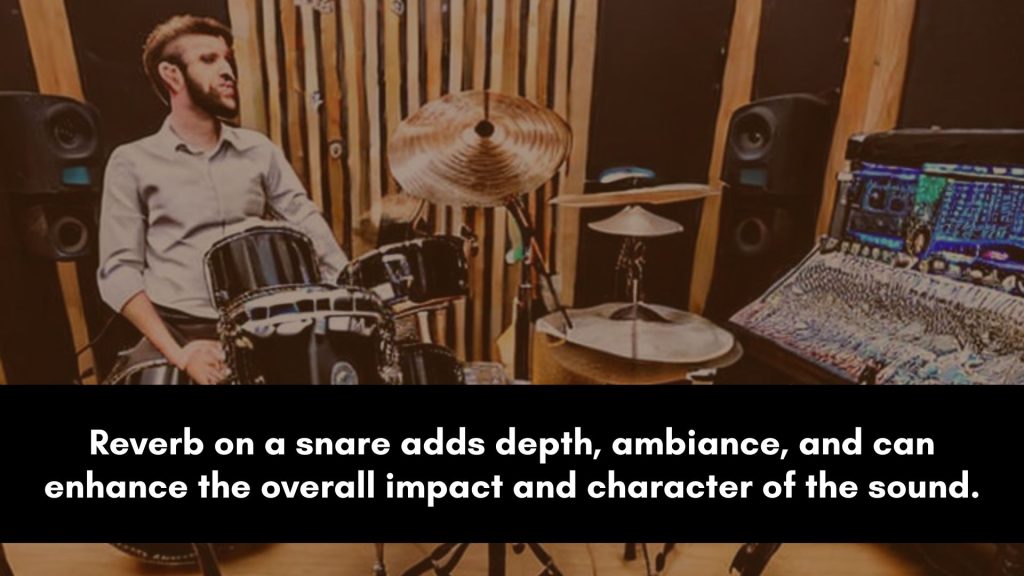
The snare lives in the center of the mix at the backbeat. It is the second-most-tracked element after the lead vocal.
That position changes the reverb job entirely.
Vocal reverb can sit on the same axis as the dry voice because both are usually centered. Guitar reverb spreads across the stereo field with the guitar.
Snare reverb has to add space without obscuring the backbeat the listener is locked onto. That tension is what makes pre-delay and decay the most important settings.
Snare reverb also competes with the rest of the kit. A tail that runs past 1.5 seconds will smear into the next snare hit at most tempos.
A reverb full of low mids will pile up with the toms and the kick. Every choice below is in service of giving the snare space without trampling the kit around it.
Choose the Right Reverb Type
Five reverb types come up regularly on snare. Each has a sonic fingerprint that fits some genres and fights others.
- Plate: bright, dense, fast attack. The classic snare reverb across pop, rock, and modern productions. Sits with the snare frequency range naturally. Start here if you are unsure. See the plate reverb breakdown for the history and the parameters.
- Room: short, tight, realistic. Adds depth without washing the snare out. The default for hip-hop, R&B, and modern productions where the kit should sound like it is in a controlled space.
- Hall: long, dense, lush. Belongs on ballads, slow tempos, and orchestral work. Smears the snare on anything above 100 BPM.
- Chamber: warm, dense, vintage. Works on classic rock, soul, and indie productions. Less common in modern mixes but distinctive when it fits.
- Spring: bouncy, lo-fi, characterful. Surf rock, dub, garage, and indie. A specialty choice that defines the production when used.
The wrong type fights the snare more than the right type helps. If the snare is buried after you add reverb, the answer is usually a different type before it is more EQ.
The Two Settings That Matter Most: Pre-Delay and Decay
Pre-delay is the gap between the dry hit and the first audible reverb. Decay is how long the reverb tail lasts. These two settings do 80 percent of the work on a snare reverb.
The rest of the parameters are character; these two are anatomy.
Set pre-delay to 20–40 ms for most snare reverbs. Below 20 ms the reverb smears into the transient, and the snare loses its crack.
Above 50 ms the reverb starts to sound like a slap-back echo.
The 20–40 ms window keeps the dry transient clear and lets the reverb arrive behind it as a tail, not a layer on top.
Set decay between 0.5 and 1.5 seconds.
The right value depends on tempo. At 120 BPM a snare hits every half-second; a decay over 1 second will smear into the next hit.
Faster tempos need shorter decays. Ballads and slow songs can tolerate 2 to 3 seconds when the type is a hall and the arrangement is sparse.
Tempo-sync the decay to dotted or half-bar values when your plugin offers it. The reverb tail then breathes with the song instead of fighting against it.
EQ the Reverb Return
An untreated reverb return pushes low-mid mud into the mix and adds high-frequency hash that piles up with the cymbals.
EQ on the return is what keeps the reverb adding space without adding noise. This is the move that separates amateur reverb from professional reverb.
High-pass the return at 200–300 Hz. This cuts the low-mid mud and stops the reverb from competing with the kick and bass.
Low-pass at 6–8 kHz to roll off the brightness that piles up with the cymbals. The result is a reverb that sits in the snare’s natural frequency range, not above or below it.
For more aggressive shaping, the Abbey Road reverb trick uses a high-pass at 600 Hz and a low-pass at 10 kHz.
That carves an even narrower window where the reverb lives, which keeps a busy mix uncluttered.
Try the standard 200–300 / 6–8 first; reach for the Abbey Road bracketing when the mix is dense.
Settings Cheat Sheet by Genre
Starting points by genre. Load the type, set pre-delay and decay, EQ the return, then adjust by ear against the rest of the kit.
| Genre | Type | Pre-delay | Decay | Mix level | Mono / Stereo |
|---|---|---|---|---|---|
| Rock | Plate | 20–40 ms | 1.0–1.5 s | 15–25% | Stereo |
| Pop | Plate or short room | 20–30 ms | 0.6–1.0 s | 10–20% | Stereo |
| Hip-Hop / R&B | Short room | 10–25 ms | 0.4–0.8 s | 10–15% | Mono leaning |
| Metal | Plate, dense | 20–30 ms | 0.8–1.2 s | 10–15% | Stereo |
| Jazz / Acoustic | Hall or chamber | 30–50 ms | 1.5–2.5 s | 20–30% | Stereo |
| Electronic / EDM | Plate, modulated | 15–30 ms | 0.6–1.2 s | 15–25% | Stereo |
| Indie / Lo-Fi | Spring or chamber | 20–40 ms | 1.0–1.8 s | 20–30% | Stereo |
| Ballad | Hall | 40–60 ms | 2.0–3.0 s | 20–30% | Stereo, wide |
Mono vs. Stereo on Snare Reverb
The dry snare is mono and panned center. Snare reverb is almost always stereo. That contrast is what gives the snare width without pulling the dry hit off center.
Send the snare to a stereo reverb on an aux bus. Set the reverb’s stereo image wide (most plugins let you choose 100 percent stereo or narrower).
The dry snare stays anchored in the middle of the mix. The reverb tails open across the stereo field. Both jobs done, no compromise.
The exception is hip-hop and R&B, where mono reverb (or a very narrow stereo return) keeps the snare tight and forward.
Wide reverb on these genres often sounds dated or out of place. Match the reverb width to what the genre expects.
3 Common Mistakes to Avoid
These three show up in almost every beginner mix. Every fix is one of the moves already covered above.
- 1. Too much reverb level. If you can obviously hear the reverb tail in solo, you have too much. Reverb works as space, not as a sound. Pull the send back until the reverb is barely audible on its own; the snare should still feel bigger with it on.
- 2. No pre-delay. Zero pre-delay smears the reverb into the transient, and the snare loses its crack. Always set 20 to 40 ms unless you specifically want a layered slap-back effect. The pre-delay is what keeps the dry hit clear.
- 3. Skipping EQ on the return. An unfiltered reverb adds low-mid mud and high-frequency hash. High-pass at 200 to 300 Hz, low-pass at 6 to 8 kHz on the return. The reverb instantly stops competing with the kick, bass, and cymbals.
Frequently Asked Questions
Six quick answers to the snare-reverb questions that stall a mix most: type, timing, width, and routing.
What is the best reverb for a snare drum?
Plate reverb is the default for most modern productions. It has a dense, bright sound that sits in the snare’s frequency range naturally.
Short room reverb is the next most common choice, especially for hip-hop, R&B, and tight modern productions.
Hall reverb belongs on ballads and slower tempos where the long tail has space to breathe.
What should pre-delay be on a snare reverb?
Twenty to 40 ms for almost every snare reverb. This window keeps the dry transient clear and lets the reverb arrive behind it as a tail, not a layer on top.
Below 20 ms the reverb smears into the transient, and the snare loses its crack. Above 50 ms the reverb starts to sound like a slap-back echo rather than space.
How long should a snare reverb decay be?
Between 0.5 and 1.5 seconds for most snare reverbs. Faster tempos need shorter decays so the reverb does not smear into the next hit.
A 120 BPM song hits every half-second; a decay over 1 second will overlap.
Ballads and slow songs can tolerate 2 to 3 seconds when the type is a hall and the arrangement leaves space for the tail.
Should snare reverb be mono or stereo?
Almost always stereo. The dry snare stays mono and centered; the stereo reverb opens up across the stereo field to give the snare width without pulling the dry hit off center.
The exception is hip-hop and R&B, where mono or narrow-stereo reverb keeps the snare tight and forward.
Match the width to the genre.
Should I put reverb on the snare as an insert or a send?
Always a send. A send lets you blend the dry snare and the wet reverb independently.
It also lets multiple instruments share the same reverb for cohesion, snare and toms on the same plate, for example.
Insert reverbs lock you into a fixed wet/dry ratio and prevent the kind of detailed blending professional mixes rely on.
Why does my snare sound washy after adding reverb?
Three usual causes. First, the reverb level is too high. Pull the send back until the reverb is just barely audible on its own.
Second, the decay is too long for the tempo. Drop it to 0.5 to 1.0 seconds for fast songs. Third, the return is not EQ’d.
High-pass at 200 to 300 Hz and low-pass at 6 to 8 kHz to clear mud and brightness.
The Bottom Line
Great snare reverb comes down to four moves. Pick the right type for the genre. Set pre-delay at 20 to 40 ms.
Tune decay to the tempo. EQ the return to clear mud and brightness. Everything else is fine-tuning around those four.
Reverb is the last touch on a snare that is already EQ’d and compressed.
How to mix snare drum runs those earlier stages, and the complete drums mixing guide sets the whole snare beside every other piece of the kit.